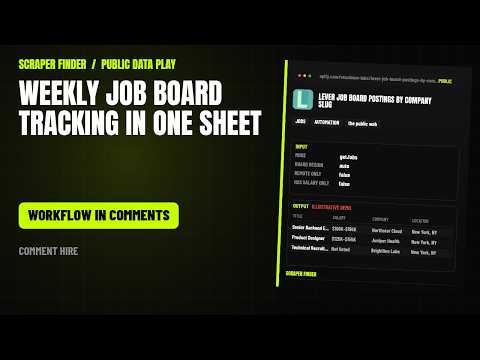
Lever job board scraper in n8n
Pull open job postings from one or more Lever.co company boards, or fetch specific postings by ID, with location, team, salary range, requirements, and apply links, filterable by team, location, and commitment type.
What this workflow does
Import it and n8n runs the Lever Job Board Postings by Company Slug Actor on Apify every day at 08:00 with the starter input below. Each row comes back with title, company slug, location, workplace type and 4 more. A Google Sheets append is included and stays off until you add your sheet. The only credential it needs is your Apify API token.
Read from the workflow file, built for Lever Job Board Postings by Company Slug version 2.0.1. Updated 2026-11-14.How the rows travel
6 nodes, in the order n8n runs them. The yellow stop is the call to the Apify Actor; the dashed stop is optional.
- Daily trigger Schedule trigger
- Configure input Code
- Run Apify Actor HTTP Request
- Normalize + dedupe Code
- Rows ready No operation
- Google Sheets (optional) Google Sheets, off until you switch it on
From the Short
This workflow is the one the video points to: the number in each video opens this page.
Input
The Configure input node holds the starter input. Change it there; every setting the Actor accepts is listed below.
{
  "companySlugs": [
    "wealthfront"
  ],
  "maxItems": 25,
  "mode": "getJobs",
  "location": "New York, NY"
}| Setting | Type | Required | Default | What it does |
|---|---|---|---|---|
| mode | string | Yes | getJobs | Fetch every open posting from one or more boards, or fetch specific postings by ID or URL. One of: getJobs, getJob. |
| companySlugs | array | No | – | Company slugs, board URLs, API URLs or posting URLs. Examples: "wealthfront", "https://jobs.lever.co/wealthfront", "https://jobs.eu.lever.co/olx"… |
| companySlug | string | No | – | Company slug, board URL, API URL or posting URL used with postingIds (mode=getJob). |
| postingIds | array | No | – | Posting UUIDs or posting/apply URLs (mode=getJob). |
| boardRegion | string | No | auto | Use auto to try the global board first and fall back to the EU board when global returns 404 or no postings. One of: auto, global, eu. |
| team | string | No | – | Keep postings whose team contains this text (case-insensitive). |
| department | string | No | – | Keep postings whose department contains this text (case-insensitive). |
| location | string | No | – | Keep postings whose primary location or any additional location contains this text (case-insensitive), e.g. "London" or "Remote". |
| commitment | string | No | – | Keep postings whose commitment or normalized employment type matches this text, e.g. "Full-time", "Contract", "Internship". |
| workplaceType | string | No | – | Keep postings with this exact workplace arrangement. One of: remote, hybrid, onsite, unspecified. |
| remoteOnly | boolean | No | false | Keep only postings marked remote or with a remote location. |
| country | string | No | – | Keep postings for one ISO 3166-1 alpha-2 country code, e.g. "US", "DE" or "IN". |
| titleKeywords | array | No | – | Keep postings whose title contains every word in this list, in any order. |
| excludeTitleKeywords | array | No | – | Drop postings whose title contains any word in this list. |
| postedAfter | string | No | – | Keep postings created on or after this date (YYYY-MM-DD). |
| hasSalaryOnly | boolean | No | false | Keep only postings with a structured salary range published by Lever. |
| salaryMin | integer | No | – | Keep postings whose structured salary range starts at or above this value (same currency and interval as the posting). |
| maxItems | integer | No | 500 | Maximum number of posting records to emit. |
| maxItemsPerCompany | integer | No | 0 | Maximum records per company board; 0 means no per-company limit. |
| includeDescription | boolean | No | true | Include full and section descriptions plus requirement lists. |
| includeHtml | boolean | No | false | Add the original HTML for descriptions, additional text and list content. |
| onlyNewSinceLastRun | boolean | No | false | Emit only postings not seen by an earlier run with the same query shape. The first run returns everything. |
What each row holds
Every field the Actor returns stays in the row (8 in its dataset schema). Normalize + dedupe trims text, drops empty fields and adds _source and _scrapedAt. The main fields:
| Field | What it is |
|---|---|
| title | Title |
| companySlug | Company Slug |
| location | Location |
| workplaceType | Workplace Type |
| employmentType | Employment Type |
| salaryText | Salary Text |
| createdAt | Created At |
| hostedUrl | Hosted Url |
What the first run costs
With the starter input (maxItems = 25) a first run costs about $0.42 on the Apify Free plan: $0.40 to start the run at 4 GB of memory and $0.02 for the results, plus platform usage.
The Actor lists $0.99 per 1,000 results; its catalogue page breaks the price down by Apify plan. The Apify Free plan includes $5 of usage a month.
The Actor behind it
Lever Job Board Postings by Company Slug: Pull open job postings from one or more Lever.co company boards, or fetch specific postings by ID, with location, team, salary range, requirements, and apply links, filterable by team, location, and commitment type.
The same job from an AI agent
The matching agent skill gives Claude Code, Codex, Cursor and other agents the same Actor, input and fields. Install it in one line:
npx skills add https://scraperfinder.com --skill lever-job-board-postings-by-company-slug The lever job board scraper skill, with manual install and run steps
Questions people ask
How do I import this workflow into n8n?
Copy https://scraperfinder.com/n8n/lever-job-board-postings-by-company-slug.json. In n8n, open a new workflow, click the three-dot menu, choose Import from URL and paste it. Or download the JSON file and use Import from File; both give the same 6 nodes.
Do I need an Apify account?
Yes. The workflow calls the Lever Job Board Postings by Company Slug Actor through the Apify API with your own token, and each run is billed to your Apify account. The Free plan includes $5 of usage a month.
What does a run cost?
With the starter input (maxItems = 25) a first run costs about $0.42 on the Apify Free plan: $0.40 to start the run at 4 GB of memory and $0.02 for the results, plus platform usage. The Actor's Store page shows the current price.
Can I change what it collects?
Yes: edit the input object in the Configure input node. The Actor takes 22 settings; the table on this page lists each one with its default. Raise maxItems once the first rows look right.
Does it work without Google Sheets?
Yes. The rows wait in the Rows ready node, so you can connect any other node there: a database, Airtable, a webhook or an email. The Google Sheets node is only one option.
Workflow updated 2026-11-14